ABDF’s Financial Instruments and Economic Impact Mechanism
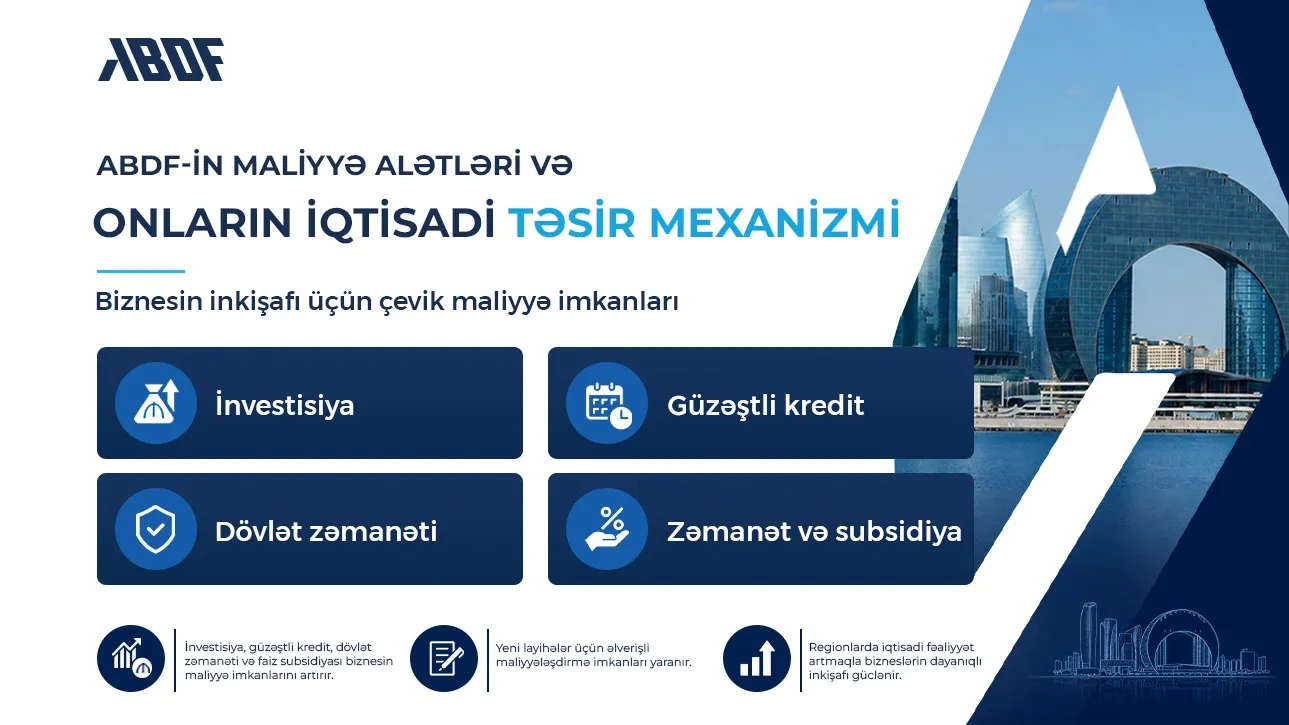
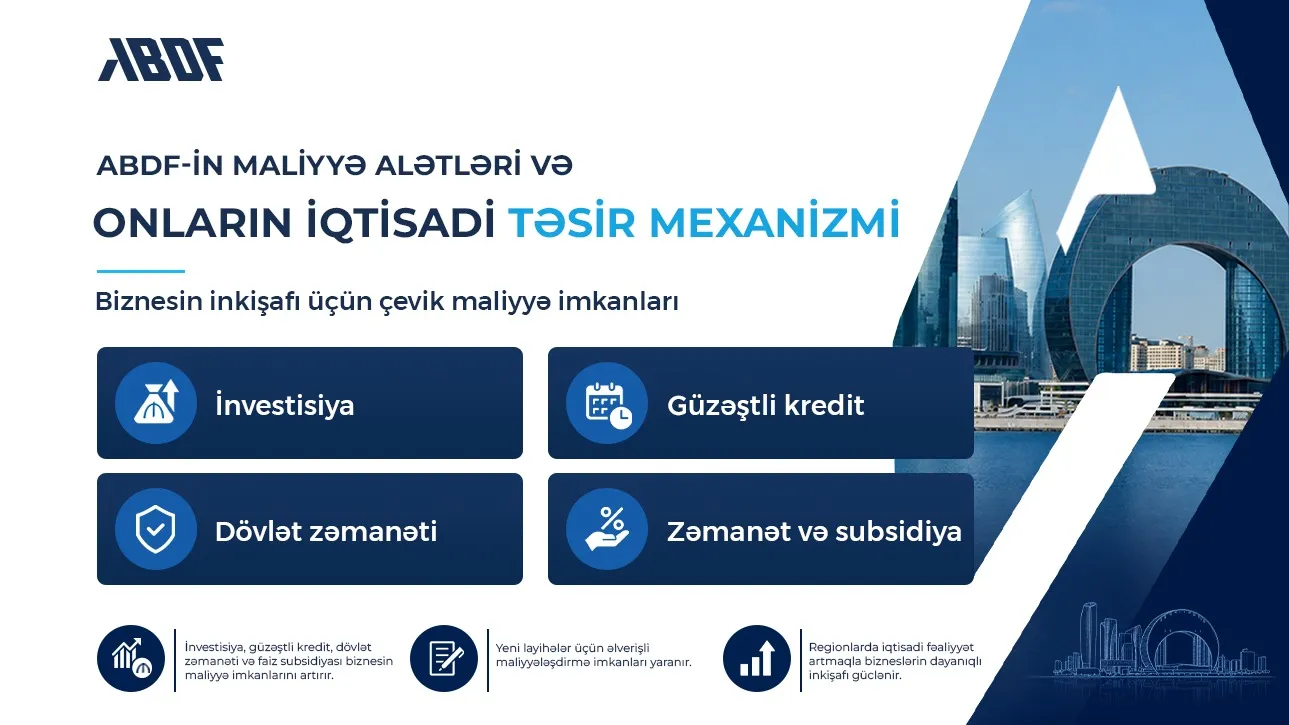
The Azerbaijan Business Development Fund (ABDF) combines the capabilities of the Azerbaijan Investment Company and the Entrepreneurship Development Fund in a unified and coordinated form. As a result of this merger, the state’s support instruments for the business environment (equity investments, preferential loans, guarantees and subsidies) have been brought together on a single platform.
The main feature of this approach is that it does not rely on a single financial instrument. Instead, different solutions are offered to suit different risk levels, business sizes and development stages. As a result, suitable financing opportunities are created for both large investment projects and small and medium-sized businesses.
The investment mechanism in this structure is geared mainly toward large projects and is applied on the basis of specific parameters. Under this mechanism, the minimum investment in the charter capital of a project company is 500,000 manat. The established conditions are not arbitrary. The Fund does not take full control of the project, but ensures risk sharing by participating with a stake of up to 30 percent. As a result, the entrepreneur retains management capabilities, while the Fund participates in the project under safer and more balanced conditions.
The requirement of a minimum internal rate of return (IRR) of 10 percent ensures the selection of only economically justified projects. This approach creates conditions for the implementation of sustainable projects with development potential in the country.
Limiting the participation period to 5–7 years shows that the Fund acts in a project not as a permanent partner, but as a financial partner at its development stage, aiming to exit the project after a certain period. This approach allows the project, once it reaches a certain stage of development, to operate independently on market principles, while enabling the Fund’s resources to be directed to new projects.
The preferential loan mechanism covers entrepreneurs operating in priority areas of the economy, and its impact is shaped by the favorable terms offered. Providing loans in amounts from 5,000 manat to 10,000,000 manat for terms of up to 10 years enables entrepreneurs to carry out projects of various scales.
Setting the annual interest rate at up to 5 percent significantly reduces the financial burden on entrepreneurs compared with market terms and creates more favorable conditions for making new investment decisions.
The grace period, applied for up to half of the loan term, is of particular importance. Thanks to this option, the business does not face the burden of repaying the principal before it begins to generate income. As a result, the likelihood of successful project operation increases, and the risk of financial difficulty and bankruptcy at an early stage is reduced.
The state guarantee and interest subsidy mechanism covers business loans of up to 5 million manat obtained by entrepreneurs from authorized credit institutions. Authorized credit institutions include banks, non-bank credit institutions, as well as commercial legal entities engaged in leasing, factoring and investment activities.
Applied since 2024, this mechanism currently covers projects implemented in the liberated territories. Under the Decree of the President of the Republic of Azerbaijan dated June 9, 2026, the mechanism is expected to be extended in the near future to other regions as well, excluding the city of Baku and the Absheron district.
Under the mechanism, the provision of a state guarantee is one of the main instruments reducing the risks of authorized credit institutions. Securing by state guarantee up to 90 percent of loans obtained by entrepreneurs for projects in the liberated territories, and up to 50 percent in other regions, significantly reduces the risk of non-repayment of loan funds.
As a result, the collateral requirements of banks and other authorized credit institutions are eased, and their interest in financing business projects with high economic potential increases.
In addition, with the maximum annual interest rate on loans set at 13 percent, half of the interest burden is subsidized by the state for up to 36 months. Thus, during that period, the entrepreneur pays only the remaining portion of the accrued interest. This approach reduces financial pressure at the most vulnerable stage of business development and allows more efficient cash flow management.
Setting the loan term at up to 7 years and the grace period at up to 36 months allows the repayment schedule to be built in line with the business’s actual cash flow. Deferring principal payments in the initial period gives the entrepreneur the opportunity to bring operations to a stable stage, generate income, and make subsequent payments more sustainably.
Thus, the financial instruments offered by ABDF create real economic impact not in isolation, but as complementary, comprehensive mechanisms. These instruments expand entrepreneurs’ access to financial resources, reduce investment risks, encourage the implementation of new projects, and support the sustainable development of businesses.
As a result, the country’s business environment becomes more inclusive, economic activity in the regions rises, and a solid foundation is formed for long-term sustainable development.